Showing posts with label database. Show all posts

Wednesday, May 2, 2012

Not All Properties Are Created Equal (Part II: Says Who!?)

It is said that Beauty is in the eye of the beholder. If one were developing a data model for Person, there are various properties that might be attached. Unlike some other properties, it might be more self-evident that a property like isBeautiful would be problematic because it begs the question “Says who?”. There is a relationship between a particular beholder and a particular beheld, in which an isBeautiful property would be more appropriately placed. It may even be a many-to-many relationship with multiple values of isBeautiful coming from multiple beholders as in a beauty pageant panel of judges. Or, as in the case study below, the credit grade of a banking customer is actually several grades, coming from different bankers and algorithms over the life of the business relationship, and international banking regulations now mandate their tracking and optimization.

Of the many subcategories of properties that Philosophers have come up with, an important pair are what John Locke named Primary and Secondary Properties (aka Qualities). The distinction between them being that Primary properties are those that are “objective” and “in the object”, while Secondary properties are “subjective” and “in the mind of the perceiver”. Primary properties of an apple would be its mass, shape, size, etc. Secondary properties would be its color, taste, smell, etc.

That apple isn't really red?
Color is a classic case in point because it seems that color might be objective.  There are surely some collection of wavelengths of light reflected off an apple that could be classifiable as “red”. Alas, there are mountains of evidence that color perception depends on the person and the external conditions.

A famous mountain of evidence (sorry, pun intended) is Ayer’s Rock (aka Uluru) in Australia which attracts thousands of tourists to see it dramatically change colors right before their eyes. Over the minutes of sunset or sunrise, “the color” ranges thru black, red, pink, orange, brown, etc.

In the rain it even turns blue and purple...


So, the mountain can’t really have a simple “color” property with a simple single value.


Again, as with Essential properties, how is this primary/secondary distinction supposed to make me develop differently than I do now?
  • Model Clarity: Keeping the properties of an entity or class limited to primary qualities helps to insure that your data model will match data models developed by others. You will be more likely to agree on what the properties are in the first place, and, on what data type best represents that property (see Stronger Types below).

  • Better Normalization: Your entity database tables are normalized when limiting to Primary properties because those truly are properties of that entity. By recognizing and removing Secondary properties, you won’t be mixing in columns that are really a flattened relationship with some other beholder entity.

  • Better Keys: When deciding which properties of an entity are candidates for being part of it’s “key” or “identifier”, it definitely helps to verify they are really objective properties of the entity. Otherwise, they are based on some external beholder & conditions that can change over time, even though the entity itself didn’t change! A drivers license search will fail if a witness’ notion of a suspect’s hair-color doesn’t match the DMV’s notion of that hair-color.

  • Data Provenance: Realizing that each value of a secondary property begs the question “says who?”, you need to identify the authority that provided each value for that property. As you can see, there could be anything from a one-to-one to a many-to-many relationship between the original class and the various authorities providing data values. If the answer is “all values of this property come from a single source X”, then that need merely be noted in the documentation.  At the other end of the spectrum, there may need to be a sophisticated sub-model just to keep track of the source and circumstances of each of the several values that property could take on for a single object! (see the Basel II banking case study below).

  • Stronger Types: Authorities providing data values for secondary properties, usually define entire “types” rather than just values from some universal type. For example, authorities specifying colors usually limit them to a custom collection of colors (i.e. a palette), or even collections of palettes.  Ralph Lauren defines many palettes of colors, most with one or more “reds”, but none of them are the same as the “red” of a 1964 Ford Mustang which comes from the small palette of factory colors from Ford for that year. If you need the simplicity of a single universal “red” value then you are looking at defining mappings from one palette to another. Car salesmen do this mapping intuitively by showing you a "cypress pearl"Infiniti when you ask to see either "black" cars, or "green" cars. Do you need that sort of detailed modeling? You do if you are trying to make it easy for customers to find what they want (see the fabric.com case study below).
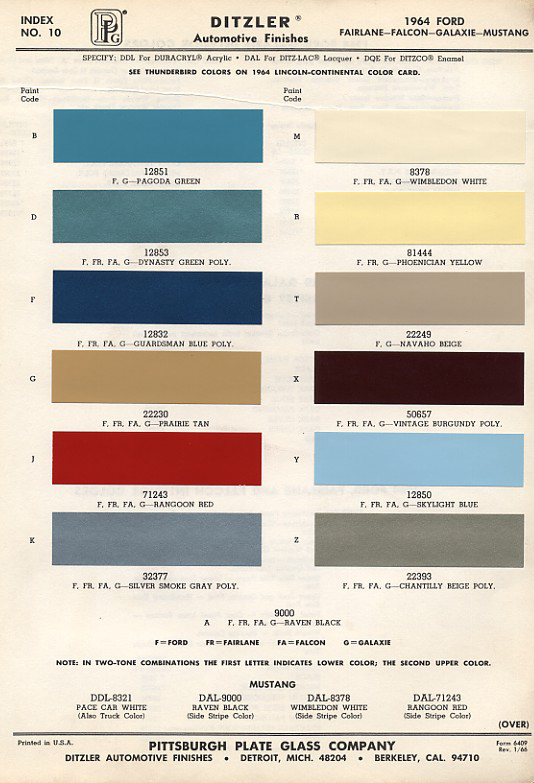
1964 Mustang Factory Colors

Ralph Lauren Palette

Case Study: Basel II Banking Accord

One of the fundamental practices of banks is to keep a certain amount of money in reserve. When taking customer deposits in, and loaning it out to make a profit from the interest charged, there is a danger if all the deposits are handed out as loans. So, a reserve must be kept, but, there is a conflict between larger reserves for more safety and smaller reserves for more profit. Because banks have erred on the side of more profit, over the past several years international banking regulations have added requirements that the amount of reserve be calculated on a more scientific basis, and be optimized over time.

One of the major criteria in determining how much reserve is required, is to base it on the quality of the customers that the bank lends money to, as measured by their credit grades. A credit grade is really just a prediction of how likely a borrower is to pay back a loan, and how much they would leave unpaid if they did default on a loan.

The regulators recognized (though maybe not in these philosophical terms) that “credit grade” is not a primary property of a customer; it is a secondary property based on the grader and the procedure or algorithm used. The Basel II Banking Accord specified that simply keeping track of customer credit grades was not enough.  Banks needed to start keeping track of “says who?” and “what did they base it on?”. With this data, it can be verified after the fact which of these predictions of future default panned out. This enables evolving better algorithms and weeding out graders and methods that were not very good.

Case Study: fabric.com

In the early days of marketing on the web, the start-up fabric.com (since bought by Amazon) was building a web store to sell clearance fabrics and apparel. Like all online retailers, there is the problem of making it easy for the customer to find the products they want. A common approach is to build a web site with a left-column navigation bar containing filter-by-property controls. This works fine for Primary properties, but is more of a problem for Secondary properties.

Alas, if one doesn’t know that there is a difference, one builds all of the filters in the same manner. For fabrics, filtering by the dimensions of the piece being sold is straightforward and effective because it is a primary property. For color however, there are problems because it is a secondary property, and hence opinions differ on how to describe the color.

Look, even though the “color” of a fabric may be in the eye of the beholder, it is an objective fact that the manufacturer described the color as X, right?. How about we use that since we have to pick something
Well, two big problems:
  • All those colorful color descriptions cause an overly large list of colors in the color filter, plus related colors are spread all thru the list (e.g. avocado, green, lime, olive, etc
  • When the customer searches for “green”, she won’t find all those fabrics with the color described as “lime”.
Okay, fine, we are going to have to go to the trouble of mapping each item to a simple set of colors that we pick. So, Mr. Programmer, go set up a set of simple colors in the database so that we can pick the color when we enter these items into inventory. Well, one other big problem:
  • While everyone is entitled to their own opinion, some opinions are worth more than others.  The programmers did not have the industry experience needed to pick an appropriate set of colors.  It was the brick and mortar fabric sellers that knew things like “stripe is a color”! So, it took someone who had experience with what buyers actually ask for to know that along with “green” in the color list, also needed was “green and white stripe” but not the manufacturer’s description “lime and white stripe”. They also knew that, in addition to simple color families like yellow and brown, subtle categories like "gold, “beige”, and “cream” were needed (and in fact the last two combined into a single category). On the other hand the green family did not need to be augmented by “lime” and "avocado" families.
SO, just as with Essential properties, more important than any particular use case is knowing that there IS a distinction between objective intrinsic Primary properties versus Secondary properties which are in the eye of the beholder.

Tuesday, August 10, 2010

Not All Properties Are Created Equal (Part I: Essentials)

Just a few years ago, I started reading “Philosophy 101” type books and I was immediately surprised at how relevant the ideas were to day to day software development.  So relevant, in fact, that an even bigger surprise is that these ideas are not part of the basic computer science curriculum, nor mentioned in technical books & magazines (with the possible exception of graduate level artificial intelligence). The following idea was the first I encountered that made it clear to me that programmers need to know what philosophers already know. It was also my first clue that philosophy has a whole body of knowledge about developing data & object models that computer science books leave up to intuition.

Did you know that 2500 years ago, philosophers like Plato and Aristotle were doing Object-Oriented Analysis and Entity-Relationship Modeling? More surprisingly, they were already more sophisticated than software developers are now!   Why?  Well, for one thing, they already understood that the properties of an object are not all created equal.  Whereas programmers today basically think that a property is a property, even ancient philosophers understood that there are several different categories of properties. And most importantly, only some properties define WHAT something is; the other properties merely describe HOW it is. Embracing this distinction will change the way you carve up the world into classes and relationships, and which attributes you assign to which entities.  I have come to feel that creating data models without this distinction is like wearing glasses so out of focus that distinct objects blur together into indistinguishable blobs. 

The properties that something must have, in order to be what it is, Philosophy calls Essential properties. Those properties that something may optionally have are called Accidental properties. For example, for you to be a human, you must have human DNA; it is an Essential property. Being named Smith, however, is an Accidental property because you would still be human even if you had a different name or even no name.  So, our everyday meaning for “essential” is different than the philosophical meaning. If a client says that the address is an essential part of the customer data, that doesn’t mean that it is Essential in the philosophical sense. In fact, it is not Essential because whatever a “customer” is, it will still be that same kind of thing even if its address changes.  The distinction between essential and accidental properties is even embedded into some human languages like Irish where there are two different “is” verbs; “Tá” is used for accidentals like “He is hungry”, but the verb they call The Copula is used for essentials like “He is Hungarian”.

A hallmark of Essential properties is that they are unchanging. An object’s Essential properties can not change without that object becoming a different kind of thing. There is an ancient philosophical paradox of how something can change and yet remain the same. You are different than you were as a child, and yet you are still the same you. As Heraclitus said, "You can’t step into the same river twice because the water is always different."  The solution the Greeks came up with was that Accidental properties may change but Essential properties must remain the same (otherwise, a metamorphosis has occurred!).  This philosophy is known as Essentialism.

Socrates taught that everything has an “essential nature” that makes it the kind of thing that it is. His pupil, Plato, taught that these essences are manifest in ideal “Forms” of which all objects are mere copies. Plato’s pupil, Aristotle, taught that Essential properties were those that defined a Form, and Accidental properties were those which distinguished one individual object from another of the same kind.  Our object-oriented programming notion of Class is analogous to Plato’s Forms. Like a Class, a Form is unchanging and it pre-exists any objects which instantiate it. Naturally, Entity tables are the database equivalent of Forms with their records being the objects.

So, what is using this idea supposed to buy me? I think a case can be made for at least the following:
  1. Better definitions of entities, classes, and relationships result because it forces you to weed out all the non-essentials (pun intended). By striving to understand entity essentials, and not just normalizing data tuples, you will be more likely to accurately model the world.
  2. Better specifications result because there will now be a place to put all those unwritten (even unspoken) assumptions about the nature of the problem domain. Ironically, when gathering requirements and doing analysis, the essential properties of things are often given short shrift  because they mostly don't get stored in databases, because.…that's right, they don't change!  It is the changeable accidental properties that get stored, with the unchanging essential properties getting buried as hardwired assumptions in the programming logic.
  3. Better system interoperability results because universal essential data is separated from local accidental data. The integration of data between a customer system and a patient system and an employee system would be much easier if they had modeled the essential entity, which is Person. When customer and patient and employee are recognized as merely accidental roles of a Person, there is an immediate common entity type to synchronize on rather than widely divergent data tables.
  4. Better identity systems result because life-long identifiers will no longer be confused with changeable properties like names, addresses, and phone numbers.
Examples of using Essentialism
  • Imagine a Person table where we already understand that using the Name column as the primary key is a bad idea, simply because names are not unique.  Some are tempted to create a compound key using name plus some other column(s) like address, phone, etc.  With an Essentialism perspective it is clear that, while the compound key may be unique for the moment, it is composed of accidental properties and hence can change at any time!  Stored references to previous keys will fail. Current keys won’t match future keys.


    We want keys using essential attributes that remains fixed for the life-time of the Person. A unique, fixed, objective, essential attribute like the person’s complete DNA sequence would do the trick! However, a government issued tax ID like SSN can be a practical substitute, plus it’s better than a proprietary “customer ID” because it is something that is effectively universal, and therefore can be used to integrate databases from multiple sources.

    Lest you think this example is contrived, I witnessed a Top-5-in-the-USA bank design a customer identity system using a key composed of accidental properties rather than SSN because “we have not traditionally collected SSNs” (despite government “know your customer” security laws requiring it!)  They had to continually fix their ever-changing data because they only focused on having a “unique key”.

  • In tutorials for any technology that uses entities, the example of a “customer” entity is almost cliche. The design of databases, XML schemas, UML diagrams, SOAP messages, Java Classes, etc, etc, have all used it.  But when we ponder the essential nature of a “customer”, there is an immediate problem…


    Philosophers have devised many systems for organizing “what exists”, and one of the first of their “20 questions” is: Is its essence physical or abstract? Customers can either be a person (a physical thing that exists in time and space), or a corporation (an abstract thing that doesn't exist in space), so, which is it?  This is our clue that it isn’t an entity at all.  With some thought (and benefit of reading more philosophy), it becomes clear that “customer” is really just a role that different entities can play.  It is part of the relationship between that entity acting as customer, client, buyer and that entity acting as vendor, seller, provider.
Whatever interpretation you would give about the essential-ness of this or that property, the main point is that it is worth knowing that there IS a distinction. And more generally, Philosophy has some ideas to which we programmers need to be exposed.

Monday, March 22, 2010

Don't Call Names...It IS polite to point!

Mom always said "Don't call names!" and "It's not polite to point!".  Ok, so how am I supposed to refer to "you know who" over there?  Too late! I already "pointed" verbally when I said "over there".  But, not only is that ok for programmers, it is actually preferable to point rather than to use names. And a half-century before computers even existed, Philosophers already knew this.  So why are programmers still calling names?
A bit of background first for programmers...
The philosophical use of the word "reference" (and hence "refer") has a subtle technical meaning that, luckily for us, corresponds with the object-oriented technical term "reference".  In Philosophy, the only way words can say something about the real world is via "reference". In Java programs, the only way to say something about an object is via an "object reference".  In other programming languages it is via a "pointer".  Interestingly, according to the 20th century philosopher Bertrand Russell, the only way one can truly refer to a thing (using language) is via a "demonstrative" (i.e. pointer words like "this", "that", "those", "these").

Contrary to previous thinkers, Russell held that proper names (e.g. Joe Blow) do not "refer".  OOP programmers can relate to this because a reference (or pointer) to a Person object can access that object's properties, but the string "Joe Blow" can not...

Person p = new Person("Joe Blow");   // get an object reference "p"
p.weight = 175; // THIS WORKS!
"Joe Blow".weight = 175; // THIS DOESN'T WORK!

Now, the string/name "Joe Blow" could be used in a query that describes a Person object and returns a reference to it. And WAAAY before computers, Russell said the same thing.  Names are a description of something and not a reference to it.
(Descriptivist) Philosophers declared that names were not references because there are a number of problems in logic that arise if they are.  I have written about several of these in earlier blog posts, but in a nutshell:
  • names can change even though the object doesn't (e.g. maiden names)
  • names can have meaning over and above referencing an object (e.g. Superman vs Clark Kent)
  • objects can have more than one name (e.g. Morning Star vs Venus)
  • names can be given to objects that don't actually exist (e.g. Unicorn)
  • not every object has a name (e.g. that piece of paper over there)
While OOP programmers may know that a pointer or reference to an object is different than a "name",  many database designers haven't absorbed that yet.  Of course, they can be forgiven somewhat because the relational database model does not really give them references or pointers.  The only way to access the properties of an object (aka entity) is via a query (and hence a description).  This has led to the common practice of creating an artificial property (aka surrogate key) that can be made to have a unique, unchanging value for every different object/entity, and is a close substitute for a "reference".

On the other hand, there is also the practice of using the name property of an object (or any other real world properties) as a reference mechanism (aka natural key), and so naturally there is great debate about whether this is ok or not, and when to use one or the other.

Philosophy would counsel (as would I) to not call names (i.e. don't use natural keys), and don't use artificial keys that the world knows about (like Social Security Numbers because even those have duplicates!). Below are a few case studies of problems arising from name calling rather than pointing.  They share a base problem that the natural key data is almost never "essential" in the philosophical sense; i.e. the data is capable of changing over time even though the object is considered to be the same object.

Case Study: Yahoo Bookmarks

It turns out that once a bookmark is created on the Yahoo Bookmarks site, there is no way to change the URL associated with that bookmark.  Someone decided to use the URL as a natural key (which by definition should never change), so, the URL can't be edited.  The problem is that a "bookmark" (by my thinking) is not synonymous with a URL.  It is a marker that enables me to return to a web page.  With web sites being revamped all the time, and most URLs not being "permalinks", the same page can have it's URL change over time.  If I need to update the URL, Yahoo makes me delete the old bookmark, create a new one, and re-enter the name, comments, etc from scratch.

Case Study: Qlubb site names

There is a web portal where one can create free web sites for small organizations (i.e. clubs aka qlubbs).  To create a site, you select a club name and then customize the generic site created for you.  However, in the help page, they warn that there is no way to change the name of your club once it is created because
"We currently do not support the ability to change the Qlubb name as there may be database consistency risks. However, if your Qlubb really want to change the name, please have a Qlubb administrator send a note to help at Qlubb with your request. We will evaluate each request and perform the change manually, if it is safe to do so."
Obviously someone mistook a name for a unique and unchanging key.

Case Study: Semantic Web

For all those programmers groaning at the last example, asking how anyone can still make that old mistake in this day and age, the same thing goes on in the new frontier of the Semantic Web.  In most tutorials on the Semantic Web, or tutorials for logic programming languages like Prolog, and yes, even in my youthful whack at a semantic network database, names of things are confused with references to those things.  As I wrote about the flaw in my SN database back in 2007, this causes real problems in all the ways that Philosophers recognized a century ago.

Thursday, March 11, 2010

Some Parts have a (sex) life of their own

In heeding my earlier post which advocates that "wholes" be analyzed and modeled, rather than just their "parts", there is the danger of swinging to the opposite extreme of not considering parts as "individuals".  After all, if one can model an entire Car as having a paintColor property, with a simple value of Red, then there is no need to model Paint as an entity on its own, much less PaintMolecule or Atom.

When the parts of X are considered "stuff" instead of "things" (e.g. paint versus wheels), or, when their abstraction level is so low that they are interchangeable (like WHICH carbon atoms are in the paint), it is usually concluded that they are outside the scope of X’s model because they make no difference at the level of the whole X.  And certainly, if a whole has a property, there is no need to have each part redundantly carry the same property just to parrot the value of the whole.  For example, the case study in that earlier post chronicled the “BigBank” database, in which the record for each obligation in a facility redundantly recorded the same single “facility grade”, even though they were always graded as a whole facility.

The problem, of course, is knowing which parts are relevant at the level of the whole (i.e. the granularity of the model). In recent science news, an example of this quandary has arisen which illustrates how parts that were considered “stuff” are really individual things. It turns out that the rare chicken who grows up half-male and half-female does so in a way that is different from humans and other mammals.

Until now, it’s been assumed that body parts (and hence their constituent cells) always grew up male or female because external hormones told them to, and told them to as a whole.  The Nature paper announced the discovery that each cell in a half-and-half chicken has maleness or femaleness as an intrinsic property from birth. In mammals, if you transplant a formerly “male” cell into a “female” organ, it will start working as a female, whereas in chickens it will keep acting male.  To switch metaphors: It turns out that the car wasn’t painted red and green after the fact; each car part was already red or green ever since its manufacture, and each is resistant to change. So, cells/parts have to be modeled individually if you are building chickens/cars.

Of course, if you are only collecting (and not building) cars, you might still think of color as a property of the car as a whole. But here is the sticky part…a painful situation occurs when the car collector later needs spare parts, but their inventory database was never designed to track part colors.  I have often encountered this situation in corporate/enterprise systems that are too brittle because their data models were overly simplified.  Sometimes the problem is that the designs were based on short term goals. [This mistake is exacerbated by some development “methodologies” that advocate only designing for today’s needs.] Other times, problems result from making quick assumptions about the nature of things being modeled rather than taking a deep look (i.e. using the fruits of Philosophy’s “best practices” as developed over 2500 years). The case study ahead illustrates this scenario.

This case study comes from another BigBank project where there was an enterprise-wide project to revamp systems to use a single standard ID number for each customer.  Their (initial) proposal was published after over a year of analysis and requirements gathering. But, from the very beginning, a Customer was intuitively defined as synonymous with “legal entity”, where a legal entity has only one government Tax ID (e.g. SSN, EIN).

Because only the whole was modeled, all the other systems that needed parts granularity balked, and the project had to take another year to rework its proposal.  Many systems and business processes needed to work with individual stores, branches and managers, and they depended on having a separate “customer ID” for each location.  While many companies have separate corporations (i.e. tax IDs) for each branch, some very large companies (e.g. Walmart) do not.  Because many systems and business processes required a single bank officer to service a single customer, it would have forced thousands of branches onto a single virtual desktop.  It also turned out that, while cities have a single tax ID, some parts (e.g. the City of Atlanta) are not legally liable for the debts of other parts (e.g. the Atlanta airport) even though they all share the same single tax ID.

So, without sufficient analysis, things that seem like wholes, can really be collections of parts.

Thursday, March 4, 2010

Model Entities, not just their parts

One of the oldest puzzles in Philosophy is the paradox of how something can change and yet still be considered the same thing. After all, if “same” is defined as “identical; not different; unchanged”, then how can it “change”?  On the other hand, even if I lose that hand (pun intended), I am still the same me. In chapter 5 of Peter Cave’s new book, “this sentence is false”[1], there is a collection of example paradoxes that illustrate how our intuitions about “sameness” are inconsistent.  Some paradoxes involve entities (or properties) whose definition is "vague", as in “How many cows make up a herd?” or “At what weight does adding a pound change you into being ‘fat’?”  However, here I will be focusing on the change paradoxes involving things with a well defined set of parts. They illustrate the problem with defining something as merely the collection of its parts (unless of course “it” is truly only a collection, and not an entity in its own right).
George Washington's axe
Harry: I have here the very axe with which George Washington chopped down the cherry tree. It’s been used by my family for generations.
Sally: But this says “Made in China”!
Harry:  Well, over the years, the handle was replaced each time it wore out. Oh, and the blade’s been replaced a couple of times too.
Sally: But those are the only two parts…that’s not the same axe at all then!!

Ship of Theseus
(original paradox by Plutarch)
Theseus had a ship whose parts were replaced over time such that, at a certain point, no original pieces were left.
How can the latter ship be said to be the same ship as the original if they have no parts in common?

(sequel paradox by Hobbes)
Suppose that those old parts were stockpiled as they were being replaced, and later they were reassembled to make a ship.
NOW, which ship is the same as the original ship; the one with the original parts, or, the one with the replacement parts?
At the bottom of these paradoxes is the question of whether a thing-made-up-of-parts is the same as the collection of all its parts.  I.E. can everything that can be said of the whole thing be equally said of the collection of all its parts, and vice-versa? For 2500 years, western philosophers including Socrates, Plato, and Aristotle, right through to the 21st century, have been debating this question, generating whole libraries of book and papers.  In fact, Mereology is an entire field of study that is just about the relationship between parts and their respective wholes.

What does it mean to be an individual?

As discussed (at great length) in the book Parts[2], there is a whole spectrum of things in between “individuals” and “groups”, and they are referred to in everyday language by singular terms (e.g. person), plural terms (e.g. feet), and some words that could mean either (e.g. hair). There are individuals (say, a car), parts of individuals that are themselves individuals (say, a wheel), parts of individuals that are NOT themselves individuals (say, the paint), collections that do not form an individual (say, “the wheels of that car”), collections that DO constitute an individual (say, the car parts that comprise the engine where the engine is itself an individual), and so on, and so on.

A key to distinguishing whether a thing being referred to is truly a thing in its own right (and not just a plural reference masquerading as a single thing) is what sorts of things can be said about it.  Orchestra is an ambiguous term because it can be used as a singular or a plural as in “the orchestra IS playing” vs the equally grammatical “the orchestra ARE playing”.  If it is considered an individual then we can say things about its creation, its history, etc, whereas the plural use simply denotes a collection of players where not much can be said about “it” apart from the count of players, their average age, etc.  Relational Database programmers will recognize individuals as those that get their own record in some entity table, and plurals/sets/collections as equivalent to the result set from some arbitrary query.  SQL aggregate functions (like count, average, minimum, maximum, etc) are the only things that can be said about the result set as a whole. Result sets do not get primary keys because they are not a “thing”, whereas real individuals do (or should!) get their own personal identity key.  Even when an arbitrary query is made to look like an entity by defining a “view”, it is not always possible to perform updates against the search results because the view is not a real entity.

What does it mean to be the same?

A big problem is that there are many different flavors of “sameness” when we say that A is the same as B. Right off the bat there is a difference between Qualitative identity versus Numerical identity. Two things are qualitatively identical if they are duplicates, like a pair of dice. Two things are numerically identical if they are one and the same thing, like the Morning Star and the Evening Star (both of which are, in fact, really the planet Venus).  They are “numerically” identical in that when counting things they only count as one thing.  Another complication is that there is a difference between identity (right this second) versus Identity over time which deals with the whole question of how something can be different at two different times and yet still be considered the same thing.  For example, you are still considered numerically identical to the you of your youth even though you have clearly changed…although this gets into the even more involved topic of Personal Identity [which may or may not apply to an axe ;-) ] Traditionally, if x was identical to y, and y was identical to z, then x had to be identical to z. Relative Identity has been proposed such that this need not be true, thus allowing both the morning and evening stars to be identical to Venus but not to each other.

When specifically asking whether the paradoxical ships and axes are numerically identical, as Peter Cave points out, two of our usual criteria for being “one and the same thing” are in conflict.  They are (a) being composed of largely the same set of parts, and (b) being appropriately continuous through some region of space and time.  The continually refurbished ship meets (b) but the reassembled original parts meet (a).

In traditional logic, as formulated in Leibniz’s Law, two things are the “same” only if everything that can be said about one thing can also be said about the other. In other words, all the properties of each object/entity need to be equal if they are one and the same.  By this token, the two axes and the various ships are not the same.  Of course, this means that ANY change to ANY property causes the new thing to not be “the same” as the old. To avoid this, others have said that only essential and not accidental properties should be compared.  This means that the definitions of “ship” and “axe” should distinguish between those properties that must remain the same throughout the lifetime of the object versus those properties that may change over time.
Java Programmers can relate to the philosophical meanings of “essential” and “accidental” in the following way. [To keep this sidebar simple, think of “entity beans” where only one bean/object/instance is allowed to represent a particular real world entity (e.g. {name=Joe Blow,ssn=123456789})…i.e. there are never multiple object instances in RAM simultaneously representing Joe.]    Class definitions could have “essential” properties implemented via constants (i.e. final instance variables initialized in the constructor ala the Immutable design pattern). And, “accidental” properties are implemented via normal instance members.

The essential properties must be final because if their values were different then they would have to be a different individual.  E.G. If an instance of class Person has a constant DNA_Fingerprint_Code with value of 1234567890, it would not be correct to change that value on that same object because a person’s DNA both defines them and never changes; i.e. “essential” in the Philosophy sense. The correct procedure would be to create a new instance of Person because it must truly be a different person if it has different DNA. [Of course, this brings up the whole separate topic of the difference between changing a property’s value because it has a truly new value versus merely correcting a mistaken value.  Normally, computer software has not been designed to make this distinction even though it would make some systems much more robust, and able to reflect reality better if they did.]

The putative method IsTheSame(Object o) would compare either all properties, or only essential properties, of this and o depending on your philosophy.  [This also brings up the whole separate topic of the Java equals() method, and the many potential meanings of “equals” apparent when thinking Philosophically.]
More than the sum of its parts

So, the particular individual parts of a thing need not all be “essential” properties of that thing, and hence they may change without affecting that thing’s identity.  (You are still you even if you lose a leg or lung, but not a head). Well then, what are some potential essential properties of an individual thing?  Many advocate taking a look at Aristotle’s “four causes” of a thing, where he defined “cause” as anything that was involved in the creation of that thing.  His two main varieties of causes were intrinsic, for causes that are “in the object”, and extrinsic, for those that are not.  The two sub-varieties of intrinsic causes were material cause (the material the thing consists of) and formal cause (the thing’s form [OOP programmers think Class]).  The two sub-varieties of extrinsic causes were efficient cause (the “who” or “what” that made it happen, or “how”) and final cause (the goal, or purpose, or “why”).

By analyzing the paradoxes using Aristotle’s causes it can be argued that the Ship of Theseus is the same ship, because the form does not change, even though the material used to construct it may vary with time. Also, the Ship of Theseus would have the same purpose, that is, transporting Theseus, even though its material would change with time.  The builders and tools used may, or may not, have been the same, therefore, depending on how important the efficient cause is to you, it would make more or less of a difference.  So, giving priority in definitions to some causes over other causes can answer riddles like these.

Further more, analyzing the “causes” of a thing’s creation, forces one to agree on when a thing actually comes into and out of existence, how to tell it apart from other similar things, how to count them, how to recognize it again in the future, and so forth.  Circularly, Causes also provide justifications for those agreements.  These criteria for identity help define the sortal definition of the thing (i.e. knowing how to sort these sorts of things from other sorts of things, and being able to count them on the way).

Case Studies: BigBank “Facilities” and Customers

I worked on some projects at "BigBank" (a recently defunct Top-5-in-the-USA bank) where these Philosophy-inspired techniques would have really helped.  Here are two case studies that illustrate the problems of modeling the parts but not the wholes.

In the first case study, BigBank (in order to meet new international banking standards) needed to retrofit its computer systems to record and report on their track record in guessing whether loans would be paid off eventually.  Each guess took the form of a “default grade” for a package of loans, each known as a “facility”.

A major problem was that their various systems did not agree on the basic definition of “facility”.  This was because the definition of a “facility” went so without saying that no one actually said (in a rigorous way) what it was.  Everyone interviewed knew intuitively what one was but couldn’t quite put it into words, and when pressed, it turned out that they all had different definitions from each other.  As a result, the various systems around the bank were built with different ontologies (i.e. models of the world).  A key problem was that many of BigBank’s systems assumed that Facilities were no more than the collection of their parts, and so only the parts were recorded with no standard place to say things about each Facility as a whole.  As a result, it came as a surprise to everyone that there had never been any agreement as to when which parts belonged to which wholes, nor even when any particular whole Facility came into or out of existence. Consequently, BigBank had several different “Facility ID”s, none of which agreed which each other, hence, no way to definitively report on the history of any particular Facility.
CASE STUDY:  At BigBank, credit grades are calculated for "facilities". A facility is a collection of "obligations" (i.e. loans, lines of credit) that are being considered together as a single deal and graded as a whole. The particular set of obligations grouped into each "facility" changes over time as individual obligations get paid off or expire. Plus, changed or not, the facilities are supposed to be re-graded from time to time.  Unfortunately, some key BigBank databases only had records for individual obligations. There was no Facility entity table.

So, for example, whenever a "facility" was (re)graded, in reality, only a set of obligation records were updated, all with the same single “facility-grade”. In fact, other than the loan officer's neurons, there was no record of which obligations had been associated with which "facility" over time.  So, when there was a new requirement to store for each facility all its grading documents, there was no place to put them. Even worse, since a Facility entity had never been formally defined, the analysis had never been done to make sure everyone had the same definition of a "facility" (which they didn't).
There was no agreement on what the thing being graded actually was! For some, each individual grading event was considered a "facility" (along with its own "facility ID") because "the grading sheet is what is graded".

A second case study (which I detailed back in 2006) involves BigBank's treatment of customer information. Some BigBank systems defined Customer entities and assigned a single ID for each one, but other systems gave the same person or corporation a different ID in each state and called them Obligors. Once again, some systems modeled only the wholes (i.e. customers) and other systems only modeled the parts (i.e. obligors). And once again, because the systems working at the parts level did not tie them together as a whole, there was disagreement about which obligors belonged to which customers.  It had become so bad that the data model had to be changed to allow multiple customers to be tied to a single obligor, lest conflicting data feeds go unprocessed. It was like having Person records and BodyPart records, but needing to kludge in the ability to have multiple people associated with the same particular foot!

[1] chapter 5, this sentence is false, Peter Cave, 2009, Continuum, ISBN: 9781847062208
[2] Parts, Peter Simons, 1987, Oxford University Press
[3] Introducing Aristotle, Rupert Woodfin and Judy Groves, 2001


Wednesday, April 30, 2008

Your Pipe Inventory Record is not a Pipe

In this blog, I recently posted: Reality is the System of Record. Unfortunately, I just found a lost reminder to myself about a really good introductory example to use. Even though it didn't make it into the original post, it seems worth mentioning here anyway...

La trahison des images is a famous painting by Magritte which seems to pose a riddle.  It contains nothing but a pipe and the phrase, "This is not a pipe". However, it only seems enigmatic because the solution is too obvious.

As Art critic Robert Hughes explains in The Shock of the New, "This, indeed, is not a pipe. It is a painting; a work of art; a sign that denotes an object and triggers memory". As Magritte himself once remarked, "Of course it's not a pipe. Just try to fill it with tobacco".

In other words, it is a representation of a pipe, not to be mistaken for an actual one. And as obvious as that seems, computer system developers make the same mistake all the time. They do so when they forget that their Customer data table & business domain objects are not actual customers, but only representations, i.e. memories, i.e. copies of information.  So, as with all cached copies of external data, it is the duty of your so-called "system of record" to keep in sync with the real customer, in the real world, because Reality is the System of Record.

Thursday, April 17, 2008

Reality is the System of Record

"The system of record is the place where there is a definitive value for some unit of data... If you have no system of record for your bank account or if you have multiple systems of record for the same account, something is fundamentally wrong."
Bill Inmon, father of the data warehouse.[1]
Over my years of consulting in large enterprise environments, I've heard arguments over whose system is the "system of record" for some particular piece of data.  I have seen programmers officially acknowledge another system as the SOR, all the while building their own system as if it were.  I've also heard corporate developers say that something is a customer if and only if it has a record in the SOR (never mind what the customer thinks, nor if the record literally has the name "Donald Duck").  I've seen that same customer information system built with so little regard for mirroring the real world that it defined Frankenstein customers, some of whom were composed of parts from multiple actual people.  Owning an SOR seems to breed a certain lack of humility which (IMHO) could benefit from learning a little Philosophy.  It will teach you that you are never the system of record, and instead, merely a "faint copy" of one of many idiosyncratic conceptions of the world.

Representationalism

In modern Cognitive Science, there is the assumption that "the mind has mental representations analogous to computer data structures". The idea in Philosophy that "the mind perceives only mental images (representations) of material objects, not the objects themselves"[2] is called Representationalism (and more generally indirect realism), and it can trace its roots across 2400 years of Philosophy of Mind.  Socrates says (in Plato's Parable of the Cave) that most people only see shadows of puppets instead of reality. Aristotle said thoughts are likenesses of things, and words refer to things indirectly through thoughts.  Rene Descartes proposed that all sensory information is transmitted by the nerves to a central "theatre", where the soul makes contact with the physical body and watches it.  John Locke said, "The mind represents the external world, but does not duplicate it."  David Hume thought that ideas were "faint copies" of physical sensations.

Skepticism (i.e. the notion that we don't know what we think we know) is one of the oldest ideas in Philosophy, and the raison d'être for the entire branch called Epistemology (which asks how can we be sure we know what we think we know?).  They were born from the ancient realization that our formation of ideas, concepts, and representations out of our sensory input (hidden behind a "veil of perception") is a very inexact process, complete with optical illusions, dreams, hallucinations, color-blindness, double vision, etc, etc.  In Immanuel Kant's "Critique of Pure Reason", he argues that because our minds are hardwired to perceive the world in certain ways, they actively shape experience rather than passively record perceptions.  His claim was that our sense perception is effectively a pair of tinted glasses that we can't take off.  Because we've never seen the world without them, it takes effort to see the world as it is really is.  One of the very reasons to practice Philosophy is to understand the true nature of things and avoid the "naive realism" of "common sense". Guides to this understanding are found in the branches of Metaphysics and Ontology which explore how to understand and model the world respectively.  One of the tactics of Epistemology to aid in this effort is the doctrine of Verificationism which says that a statement has no meaning if there is not a way to verify its truth.

For programmers, the big epiphany here should be that their business database is really just one particular representation of reality, not reality itself.  Reality is the System of Record. A developer should be humble, and realize that it is difficult to accurately model the world such that it integrates with the data models of other systems.  They also should be skeptical that their actual data is both accurate and up-to-date, developing ongoing mechanisms to actively verify each. 

Syncing the Systems of Record

When any system keeps copies of data for which it is not the system of record, that system is actually just a cached copy of that external data.  And like any cache, it has the responsibility to keep track of whether its copy is "stale", and to implement mechanisms to insure "cache coherence". Once one realizes that reality is the system of record, it becomes clear that it is not enough to keep databases in sync with each other; they ALL must chase after the ever-changing state of the world.

In a large organization, each database is just one of many competing representations. In the same way that different people have different mental representations of their shared reality, different databases will each have their own slightly (or largely) incompatible data models, and sets of data values, for the same domain entities.  A side-effect of this is that many systems keep copies of external data that they've transformed in some way for their own use.  When systems don't realize that their SOR data represents the same real-world entities as other SORs do (e.g. patient DB versus employee DB), the eyesight of the entire enterprise goes out of focus as each data-set drifts apart.

CASE STUDY: ChoicePoint

ChoicePoint was an independent company prior to being bought out by Reed Elsevier in 2008.  It collected and combined data about businesses and individuals from a wide variety of sources, selling access to both private and public (i.e. government) clients.  While consulting there, I saw first hand how data was effectively only verified if someone phoned in to complain about inaccuracies. I also was informed by management that no access control mechanisms were to be included in the design of a new system, despite Congress exploring adding requirements for such.  They said that ChoicePoint wanted to be able to protest at the cost of adding the controls after the fact in the hope that it would defeat the requirements in the first place. There have been a whole series of lawsuits and government actions against ChoicePoint for out-of-date data, inaccurate data, and selling data to unauthorized buyers which cost it so much money that it had to be sold.

[1] The System of Record in the Global Data Warehouse, Bill Inmon, Information Management Magazine, May 2003
http://www.information-management.com/issues/20030501/6645-1.html

[2] Representationalism, Encyclopædia Britannica
http://www.britannica.com/EBchecked/topic/498476/representationism


Saturday, November 10, 2007

Subjective, Objective, Relative, Existential

In the imposing, but handy, Oxford Companion to Philosophy[1], there are entries about "objectivism and subjectivism"[2], and "relativism, epistemological"[3] that lead to the following observations:

  • Objectivism says that some statements are objective, in that they are true independent of anyone's opinion. e.g. This ball is red. Alternatively, values assigned to properties can be dependent on other factors and be described by a function rather than a simple value. e.g. The color of Ayer's Rock is F(time-of-day, weather).
  • Subjectivism says that (potentially all) statements are subjective, in that they are dependent on the opinion of the person making the statement. e.g. This cake is delicious.
  • Relativism says that statements are always subjective even when the decider thinks he's made an objective evaluation. I.E. no evaluations are objective because man is always biased by his particular cultural, historical, religious, etc viewpoint, and no particular viewpoint is "the right one". e.g. This society is primitive.
  • Existential Programming philosophy says that even if something is supposedly scalar & objective, and even if one does not subscribe to relativism (thus implying that there is no need to ascribe to values a particular data source), the reliability of any particular data source is never perfect, and thus one needs to model data as if relativism were true. I.E. keep track of "says who" for each "fact" and therefore be prepared to simultaneously handle/store multiple values for everything, tagging them with "says who", "said when", etc. So, in effect, there are no scalar values, only functions with at least a data source as a parameter.
[1] Oxford Companion to Philosophy, 2nd Ed, 2005
[2] ibid, pg 667
[3] ibid, pg 800


Friday, September 21, 2007

The Savant Semantic Network Database

Back in 1983, when "expert systems" where just starting to be all the rage, I had a contract (and was later hired as Chief Scientist) with a startup company that wanted to develop several microcomputer based "business" applications. I realized that they were all essentially database applications with a forms-centric user interface. [Mind you, this was back before there were real databases on PCs, and 80x24 color text was the state of the art for user interfaces.] I decided to build a general database and forms UI engine from scratch, and then quickly create the business apps (e.g. contacts, H/R data, calendar, memos, etc) using the engine. The engine eventually became a product in its own right and was dubbed Savant. Mark Wozinac (brother of the famous Woz) ran an early computer store in Silicon Valley and was an early enthusiast for the technology.

Having always been interested in AI and general knowledge representation, and with expert systems looking hot, I took a semantic networking approach. Savant had an interactive development mode where the user could move the cursor around the screen and dynamically define form fields, associating each field with an EAV (entity/attribute/value) data triple (way before the term EAV was widespread). The name of each form field was the "attribute", the value entered into the field was the "value", and the "entity" was the value of some other form field that the user specified. Savant let users create their app, complete with database, on the fly, with the form definitions stored in the same EAV database. I had some novel techniques to optimize the data retrieval (using my written from scratch B+/B* tree DB kernal). All this was written in UCSD Pascal (grandpa to Java) such that it ran on IBM PC, Radio Shack TRS80, Apple ][, and exotic 32-bit computers, and ran on FLOPPIES! Only shortly later, when Corvus hard drives for Apple ][ and the IBM XT came out, did it benefit from their size and speed. To UCSD's credit, I didn't really have to change any code.

One of my inspirations was to make a more intuitive approach for non-technical users than was required by a popular database of the day, pfs:File. It also let users create form screens and save the data from each screen into its own "table". I thought that it was too complicated to know which screen each bit of data you wanted was on, plus, you couldn't share data between screens! My goal was to have all data available from all screens/forms without having to know about tables and schemas. One would just design forms and the data would magically go to the right place.

T
he other day, I stumbled across, MindModel, a product that looks very similar to Savant (except its written for the new-fangled graphic user interface :-) It also looks like it may have the same fatal flaw that my system had. Namely, Savant didn't (because I didn't) understand that the value of a "name" attribute of an entity is not the same thing as the entity itself (nor is it a key). E.G. (JoeSmith,phone#,123-456-7890) does not represent the same information as (key123,name,JoeSmith) plus (key123,phone#,123-456-7890). So, if you change JoeSmith to JoeBlow, you either lose the association with other attributes tied to JoeSmith, or you must remap them all. So, Savant changed all the JoeSmith references to JoeBlow in all triples, but then what to do about the phone number changing? If you change all 123-456-7890 references to 321-654-9999, you have not only changed JoeSmith's phone number but anyone else who shared that number. In other words, it didn't really understand the concepts of entity and attribute.

I see the same fuzzy understanding of entities and attributes in many articles about the Semantic Web and how easy it is to encode data such that any lay person can do it intuitively. They show the same
(JoeSmith,phone#,123-456-7890) flavor examples. We all need more basic metaphysics and ontology training in grade school!