Wednesday, May 2, 2012

Not All Properties Are Created Equal (Part II: Says Who!?)

It is said that Beauty is in the eye of the beholder. If one were developing a data model for Person, there are various properties that might be attached. Unlike some other properties, it might be more self-evident that a property like isBeautiful would be problematic because it begs the question “Says who?”. There is a relationship between a particular beholder and a particular beheld, in which an isBeautiful property would be more appropriately placed. It may even be a many-to-many relationship with multiple values of isBeautiful coming from multiple beholders as in a beauty pageant panel of judges. Or, as in the case study below, the credit grade of a banking customer is actually several grades, coming from different bankers and algorithms over the life of the business relationship, and international banking regulations now mandate their tracking and optimization.

Of the many subcategories of properties that Philosophers have come up with, an important pair are what John Locke named Primary and Secondary Properties (aka Qualities). The distinction between them being that Primary properties are those that are “objective” and “in the object”, while Secondary properties are “subjective” and “in the mind of the perceiver”. Primary properties of an apple would be its mass, shape, size, etc. Secondary properties would be its color, taste, smell, etc.

That apple isn't really red?
Color is a classic case in point because it seems that color might be objective.  There are surely some collection of wavelengths of light reflected off an apple that could be classifiable as “red”. Alas, there are mountains of evidence that color perception depends on the person and the external conditions.

A famous mountain of evidence (sorry, pun intended) is Ayer’s Rock (aka Uluru) in Australia which attracts thousands of tourists to see it dramatically change colors right before their eyes. Over the minutes of sunset or sunrise, “the color” ranges thru black, red, pink, orange, brown, etc.

In the rain it even turns blue and purple...
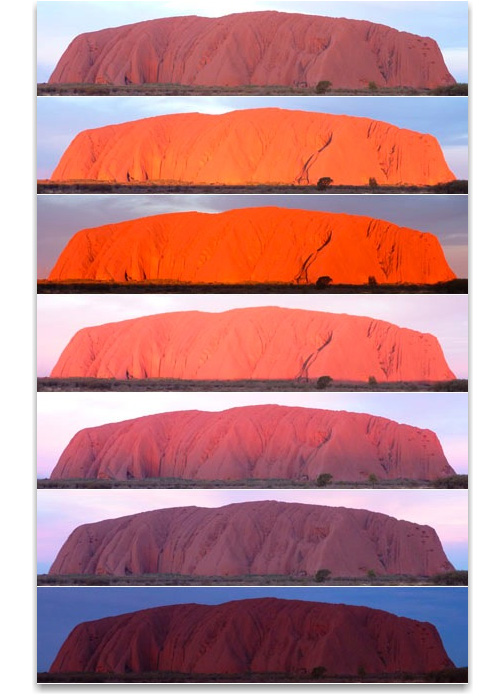

So, the mountain can’t really have a simple “color” property with a simple single value.


Again, as with Essential properties, how is this primary/secondary distinction supposed to make me develop differently than I do now?
  • Model Clarity: Keeping the properties of an entity or class limited to primary qualities helps to insure that your data model will match data models developed by others. You will be more likely to agree on what the properties are in the first place, and, on what data type best represents that property (see Stronger Types below).

  • Better Normalization: Your entity database tables are normalized when limiting to Primary properties because those truly are properties of that entity. By recognizing and removing Secondary properties, you won’t be mixing in columns that are really a flattened relationship with some other beholder entity.

  • Better Keys: When deciding which properties of an entity are candidates for being part of it’s “key” or “identifier”, it definitely helps to verify they are really objective properties of the entity. Otherwise, they are based on some external beholder & conditions that can change over time, even though the entity itself didn’t change! A drivers license search will fail if a witness’ notion of a suspect’s hair-color doesn’t match the DMV’s notion of that hair-color.

  • Data Provenance: Realizing that each value of a secondary property begs the question “says who?”, you need to identify the authority that provided each value for that property. As you can see, there could be anything from a one-to-one to a many-to-many relationship between the original class and the various authorities providing data values. If the answer is “all values of this property come from a single source X”, then that need merely be noted in the documentation.  At the other end of the spectrum, there may need to be a sophisticated sub-model just to keep track of the source and circumstances of each of the several values that property could take on for a single object! (see the Basel II banking case study below).

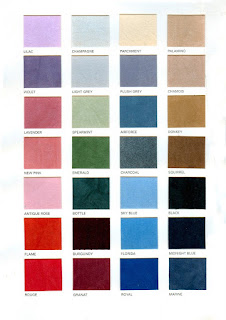
  • Stronger Types: Authorities providing data values for secondary properties, usually define entire “types” rather than just values from some universal type. For example, authorities specifying colors usually limit them to a custom collection of colors (i.e. a palette), or even collections of palettes.  Ralph Lauren defines many palettes of colors, most with one or more “reds”, but none of them are the same as the “red” of a 1964 Ford Mustang which comes from the small palette of factory colors from Ford for that year. If you need the simplicity of a single universal “red” value then you are looking at defining mappings from one palette to another. Car salesmen do this mapping intuitively by showing you a "cypress pearl"Infiniti when you ask to see either "black" cars, or "green" cars. Do you need that sort of detailed modeling? You do if you are trying to make it easy for customers to find what they want (see the fabric.com case study below).
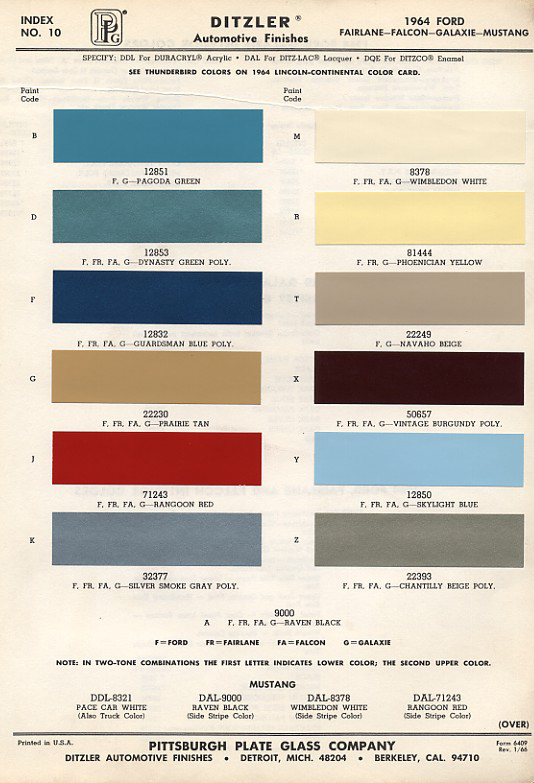
1964 Mustang Factory Colors

Ralph Lauren Palette

Case Study: Basel II Banking Accord

One of the fundamental practices of banks is to keep a certain amount of money in reserve. When taking customer deposits in, and loaning it out to make a profit from the interest charged, there is a danger if all the deposits are handed out as loans. So, a reserve must be kept, but, there is a conflict between larger reserves for more safety and smaller reserves for more profit. Because banks have erred on the side of more profit, over the past several years international banking regulations have added requirements that the amount of reserve be calculated on a more scientific basis, and be optimized over time.

One of the major criteria in determining how much reserve is required, is to base it on the quality of the customers that the bank lends money to, as measured by their credit grades. A credit grade is really just a prediction of how likely a borrower is to pay back a loan, and how much they would leave unpaid if they did default on a loan.

The regulators recognized (though maybe not in these philosophical terms) that “credit grade” is not a primary property of a customer; it is a secondary property based on the grader and the procedure or algorithm used. The Basel II Banking Accord specified that simply keeping track of customer credit grades was not enough.  Banks needed to start keeping track of “says who?” and “what did they base it on?”. With this data, it can be verified after the fact which of these predictions of future default panned out. This enables evolving better algorithms and weeding out graders and methods that were not very good.

Case Study: fabric.com

In the early days of marketing on the web, the start-up fabric.com (since bought by Amazon) was building a web store to sell clearance fabrics and apparel. Like all online retailers, there is the problem of making it easy for the customer to find the products they want. A common approach is to build a web site with a left-column navigation bar containing filter-by-property controls. This works fine for Primary properties, but is more of a problem for Secondary properties.

Alas, if one doesn’t know that there is a difference, one builds all of the filters in the same manner. For fabrics, filtering by the dimensions of the piece being sold is straightforward and effective because it is a primary property. For color however, there are problems because it is a secondary property, and hence opinions differ on how to describe the color.

Look, even though the “color” of a fabric may be in the eye of the beholder, it is an objective fact that the manufacturer described the color as X, right?. How about we use that since we have to pick something
Well, two big problems:
  • All those colorful color descriptions cause an overly large list of colors in the color filter, plus related colors are spread all thru the list (e.g. avocado, green, lime, olive, etc
  • When the customer searches for “green”, she won’t find all those fabrics with the color described as “lime”.
Okay, fine, we are going to have to go to the trouble of mapping each item to a simple set of colors that we pick. So, Mr. Programmer, go set up a set of simple colors in the database so that we can pick the color when we enter these items into inventory. Well, one other big problem:
  • While everyone is entitled to their own opinion, some opinions are worth more than others.  The programmers did not have the industry experience needed to pick an appropriate set of colors.  It was the brick and mortar fabric sellers that knew things like “stripe is a color”! So, it took someone who had experience with what buyers actually ask for to know that along with “green” in the color list, also needed was “green and white stripe” but not the manufacturer’s description “lime and white stripe”. They also knew that, in addition to simple color families like yellow and brown, subtle categories like "gold, “beige”, and “cream” were needed (and in fact the last two combined into a single category). On the other hand the green family did not need to be augmented by “lime” and "avocado" families.
SO, just as with Essential properties, more important than any particular use case is knowing that there IS a distinction between objective intrinsic Primary properties versus Secondary properties which are in the eye of the beholder.

Tuesday, September 21, 2010

Fuzzy Unit Testing, Performance Unit Testing

Because of the topic of testing coming up in my recent post "Is Morality Eating Your Own Dogfood?", it made me finally publish the following notebook entry from 2007...

In reading Philosophy 101, about Truth with a capital "T", and the non-traditional logics that use new notions of truth, we of course arrive at Fuzzy Logic with its departure from simple binary true/false values, and embrace of an arbitrarily wide range of values in between.

Contemplating this gave me a small AHA moment: Unit Testing is an area where there is an implicit assumption that "Test Passes" has either a true or false value.  How about Fuzzy Unit Testing where there is some numeric value in the 0...1 range which reports a degree of pass/fail-ness? i.e. a percentage pass/fail for each test.  For example, testing algorithms that predict something could be given a percentage pass/fail based on how well the prediction matched the actual value.  Stock market predictions, bank customer credit default prediction, etc come to mind.  This sort of testing of predictions about future defaults (i.e. credit grades) is just the sort of thing that the BASEL II accords are forcing banks to start doing.

Another great idea (if I do say so myself) that I had a few years ago was the notion that there is extra meta-data that could/should be gathered as a part of running unit test suites; specifically, the performance characteristics of each test run.  The fact that a test still passes, but is 10 times slower than the previous test run, is a very important piece of information that we don't usually get.  Archiving and reporting on this meta-data about each test run can give very interesting metrics on how the code changes are improving/degrading performance on various application features/behavior over time.  I can now see that this comparative performance data would be a form of fuzzy testing.


Tuesday, August 10, 2010

Not All Properties Are Created Equal (Part I: Essentials)

Just a few years ago, I started reading “Philosophy 101” type books and I was immediately surprised at how relevant the ideas were to day to day software development.  So relevant, in fact, that an even bigger surprise is that these ideas are not part of the basic computer science curriculum, nor mentioned in technical books & magazines (with the possible exception of graduate level artificial intelligence). The following idea was the first I encountered that made it clear to me that programmers need to know what philosophers already know. It was also my first clue that philosophy has a whole body of knowledge about developing data & object models that computer science books leave up to intuition.

Did you know that 2500 years ago, philosophers like Plato and Aristotle were doing Object-Oriented Analysis and Entity-Relationship Modeling? More surprisingly, they were already more sophisticated than software developers are now!   Why?  Well, for one thing, they already understood that the properties of an object are not all created equal.  Whereas programmers today basically think that a property is a property, even ancient philosophers understood that there are several different categories of properties. And most importantly, only some properties define WHAT something is; the other properties merely describe HOW it is. Embracing this distinction will change the way you carve up the world into classes and relationships, and which attributes you assign to which entities.  I have come to feel that creating data models without this distinction is like wearing glasses so out of focus that distinct objects blur together into indistinguishable blobs. 

The properties that something must have, in order to be what it is, Philosophy calls Essential properties. Those properties that something may optionally have are called Accidental properties. For example, for you to be a human, you must have human DNA; it is an Essential property. Being named Smith, however, is an Accidental property because you would still be human even if you had a different name or even no name.  So, our everyday meaning for “essential” is different than the philosophical meaning. If a client says that the address is an essential part of the customer data, that doesn’t mean that it is Essential in the philosophical sense. In fact, it is not Essential because whatever a “customer” is, it will still be that same kind of thing even if its address changes.  The distinction between essential and accidental properties is even embedded into some human languages like Irish where there are two different “is” verbs; “Tá” is used for accidentals like “He is hungry”, but the verb they call The Copula is used for essentials like “He is Hungarian”.

A hallmark of Essential properties is that they are unchanging. An object’s Essential properties can not change without that object becoming a different kind of thing. There is an ancient philosophical paradox of how something can change and yet remain the same. You are different than you were as a child, and yet you are still the same you. As Heraclitus said, "You can’t step into the same river twice because the water is always different."  The solution the Greeks came up with was that Accidental properties may change but Essential properties must remain the same (otherwise, a metamorphosis has occurred!).  This philosophy is known as Essentialism.

Socrates taught that everything has an “essential nature” that makes it the kind of thing that it is. His pupil, Plato, taught that these essences are manifest in ideal “Forms” of which all objects are mere copies. Plato’s pupil, Aristotle, taught that Essential properties were those that defined a Form, and Accidental properties were those which distinguished one individual object from another of the same kind.  Our object-oriented programming notion of Class is analogous to Plato’s Forms. Like a Class, a Form is unchanging and it pre-exists any objects which instantiate it. Naturally, Entity tables are the database equivalent of Forms with their records being the objects.

So, what is using this idea supposed to buy me? I think a case can be made for at least the following:
  1. Better definitions of entities, classes, and relationships result because it forces you to weed out all the non-essentials (pun intended). By striving to understand entity essentials, and not just normalizing data tuples, you will be more likely to accurately model the world.
  2. Better specifications result because there will now be a place to put all those unwritten (even unspoken) assumptions about the nature of the problem domain. Ironically, when gathering requirements and doing analysis, the essential properties of things are often given short shrift  because they mostly don't get stored in databases, because.…that's right, they don't change!  It is the changeable accidental properties that get stored, with the unchanging essential properties getting buried as hardwired assumptions in the programming logic.
  3. Better system interoperability results because universal essential data is separated from local accidental data. The integration of data between a customer system and a patient system and an employee system would be much easier if they had modeled the essential entity, which is Person. When customer and patient and employee are recognized as merely accidental roles of a Person, there is an immediate common entity type to synchronize on rather than widely divergent data tables.
  4. Better identity systems result because life-long identifiers will no longer be confused with changeable properties like names, addresses, and phone numbers.
Examples of using Essentialism
  • Imagine a Person table where we already understand that using the Name column as the primary key is a bad idea, simply because names are not unique.  Some are tempted to create a compound key using name plus some other column(s) like address, phone, etc.  With an Essentialism perspective it is clear that, while the compound key may be unique for the moment, it is composed of accidental properties and hence can change at any time!  Stored references to previous keys will fail. Current keys won’t match future keys.


    We want keys using essential attributes that remains fixed for the life-time of the Person. A unique, fixed, objective, essential attribute like the person’s complete DNA sequence would do the trick! However, a government issued tax ID like SSN can be a practical substitute, plus it’s better than a proprietary “customer ID” because it is something that is effectively universal, and therefore can be used to integrate databases from multiple sources.

    Lest you think this example is contrived, I witnessed a Top-5-in-the-USA bank design a customer identity system using a key composed of accidental properties rather than SSN because “we have not traditionally collected SSNs” (despite government “know your customer” security laws requiring it!)  They had to continually fix their ever-changing data because they only focused on having a “unique key”.

  • In tutorials for any technology that uses entities, the example of a “customer” entity is almost cliche. The design of databases, XML schemas, UML diagrams, SOAP messages, Java Classes, etc, etc, have all used it.  But when we ponder the essential nature of a “customer”, there is an immediate problem…


    Philosophers have devised many systems for organizing “what exists”, and one of the first of their “20 questions” is: Is its essence physical or abstract? Customers can either be a person (a physical thing that exists in time and space), or a corporation (an abstract thing that doesn't exist in space), so, which is it?  This is our clue that it isn’t an entity at all.  With some thought (and benefit of reading more philosophy), it becomes clear that “customer” is really just a role that different entities can play.  It is part of the relationship between that entity acting as customer, client, buyer and that entity acting as vendor, seller, provider.
Whatever interpretation you would give about the essential-ness of this or that property, the main point is that it is worth knowing that there IS a distinction. And more generally, Philosophy has some ideas to which we programmers need to be exposed.